
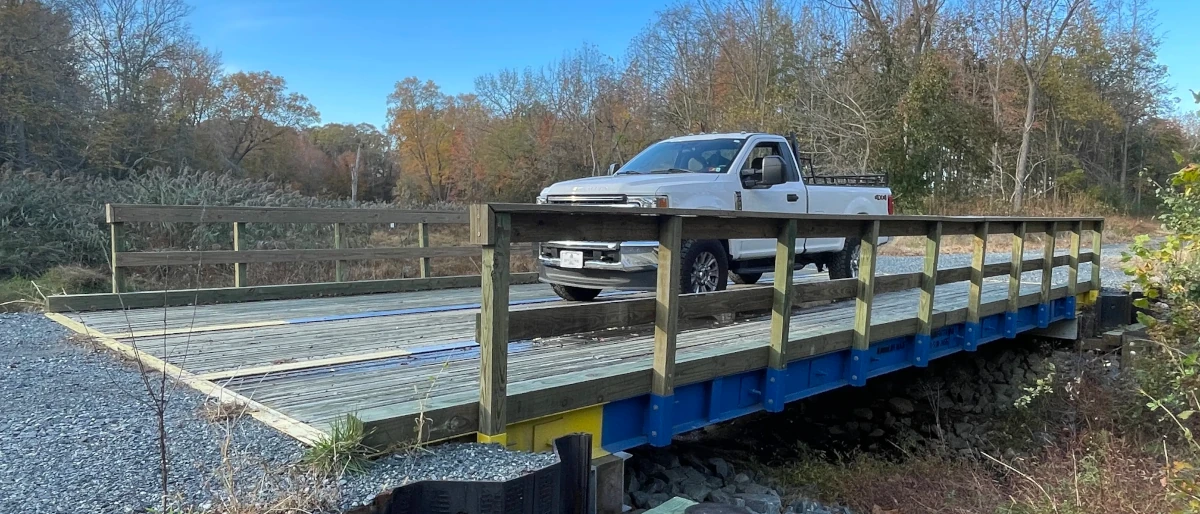
Trappe, Md. — On a quiet stretch of farmland outside the Town of Trappe, a stress-laminated timber bridge now spans a narrow stream that few people will ever see. But for those involved in the long-debated Lakeside at Trappe development, the modest structure represents more than just a crossing—it's a small but pivotal link in one of the Eastern Shore's most watched infrastructure projects.
The bridge, fabricated by E&H Manufacturing, Inc. and installed by David A. Bramble, Inc., connects the Lakeside wastewater treatment facility with its spray irrigation fields, where treated effluent will be dispersed under Maryland Department of the Environment (MDE) oversight.
Without that connection, the system simply couldn't function. The bridge had to be strong enough for heavy agricultural and maintenance equipment, yet low-impact enough to meet strict environmental conditions.
A Stream Becomes a Bottleneck
When engineers began laying out the wastewater treatment complex, they found that a small stream cut directly between the treatment lagoons and the designated spray fields—a practical barrier with regulatory consequences.
“It wasn't just about getting a vehicle across. Access is integral to the entire operation. If you can't reach the fields to maintain or monitor them, you can't run the system.”
The solution had to satisfy three competing demands:
- Provide year-round access for heavy equipment.
- Minimize disturbance within a regulated stream corridor.
- Meet the tight project schedule amid public scrutiny and ongoing environmental litigation.
That challenge led the project team—Rauch Engineering as civil engineer, Bramble as site contractor, and E&H Manufacturing as supplier—to consider a pre-engineered timber bridge system.
Choosing a Pre-Engineered Solution
E&H's bridge design is built on a straightforward concept known as stress-lamination. Each bridge panel is fabricated from 2×12 pressure-treated Southern Yellow Pine boards, stood on edge and compressed under thousands of pounds of pressure using high-tensile steel rods anchored inside structural steel channels.
The result is a solid deck that behaves like a single piece of timber—a design rated for AASHTO HS-20 (40-ton) highway loads.
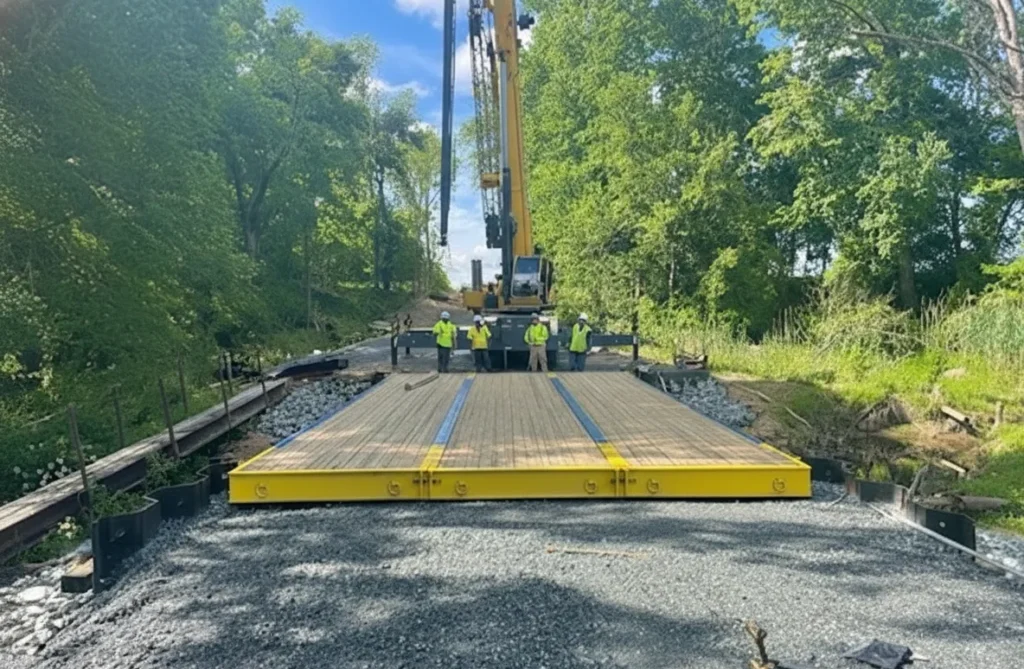
Two such panels can form a standard 12-foot drivable bridge, but at Lakeside, the team needed more. To accommodate wide farm and maintenance vehicles, the configuration was expanded to a three-panel system, creating a 19½-foot-wide deck capable of carrying large tractors and spray rigs.
Because the bridge is delivered pre-fabricated, it arrives on site as modular panels that are simply set onto prepared abutments. No cranes, falsework, or concrete curing are required. For the Lakeside project, this meant the bridge could be installed quickly, with minimal in-stream activity—a key consideration under MDE and U.S. Army Corps of Engineers permitting.
Design Coordination and Review
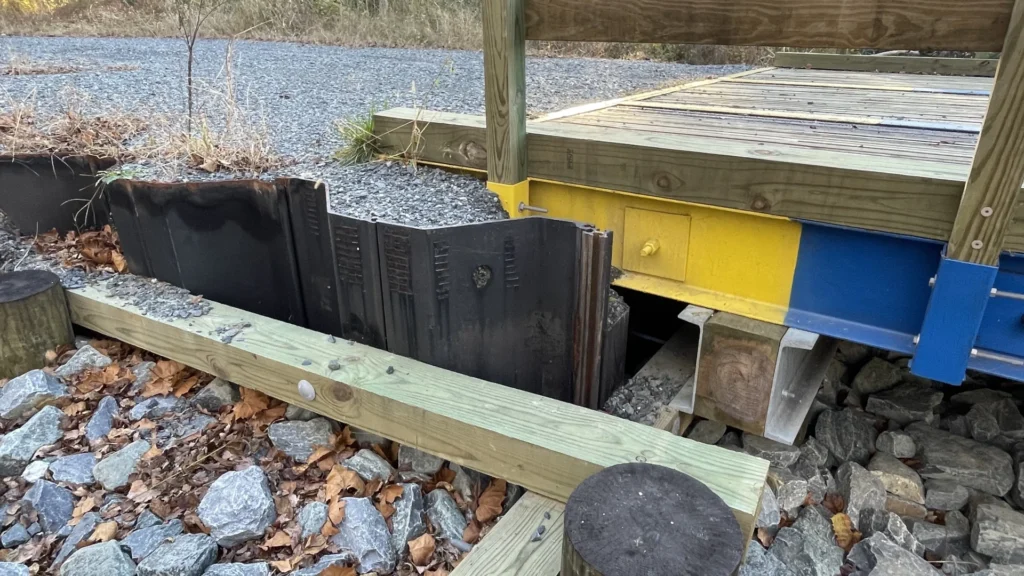
Rauch Engineering coordinated with E&H to confirm abutment geometry and bearing reactions, ensuring compatibility with the prefabricated panels.
Town reviewers raised questions about long-term service life and maintenance. In response, the team opted to omit an asphalt wearing surface, allowing the timber deck to breathe and reducing future maintenance complexity—a choice E&H supported and documented through its structural engineering data.
Once plans and submittals were approved, Bramble moved forward with procurement. The purchase order was finalized in early 2024, with E&H delivering the three-panel SL40-12 system, plus guard standards and hardware, from its West Virginia fabrication shop.
Installation in the Field
By the time the panels arrived, abutments designed by Rauch had already been built in place and ready to seat the bridge panels.
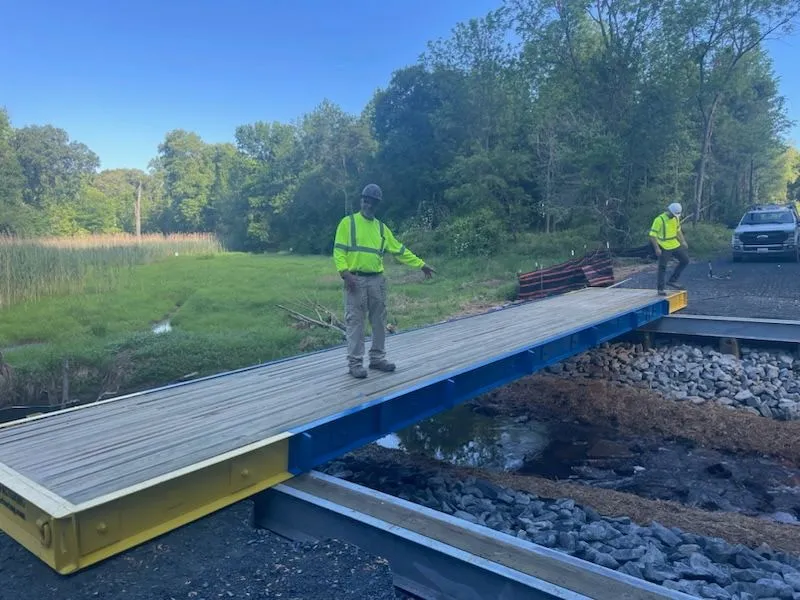
The bridge installation itself took place over just a couple of days: the three stress-laminated panels were off-loaded, aligned side-by-side, and joined with E&H's steel shear-key system—a bolted connection that locks the panels together so the deck acts as one continuous structure. Once set in place and bolted together, the bridge immediately achieved its full design strength.
The finished structure measures 40 feet long with a drivable width of about 18½ feet, equipped with 4×4 timber guard standards and mounted on concrete abutments protected by riprap. Despite its simplicity, it meets the same design load criteria used for public road bridges.
Ownership and Oversight
Because the crossing provides access to a public utility, it will ultimately be owned and maintained by the Town of Trappe. That decision also aligned with regulatory guidance: infrastructure tied to the wastewater treatment permit must remain under public ownership for accountability and long-term maintenance.
For the Town, the bridge represents one of many infrastructure components that must be completed and certified before the system can begin full operation. For the development team, it's a visible sign of progress and a literal connection between design intent and functional reality.
Small Span, Large Context
The Lakeside at Trappe project has drawn state-level attention for years, largely due to its scale and the environmental sensitivities of the Choptank River watershed. Each construction milestone, no matter how small, has carried extra scrutiny from agencies and advocacy groups alike.
That context made the bridge more than a routine farm crossing. It became a test of whether the project could move forward within the boundaries of its permits and public commitments.
By using a low-impact, pre-engineered timber design, the project team managed to reduce construction risk, stay within environmental constraints, and keep the schedule moving, without adding another layer of regulatory review.
A Simple Structure That Carries Weight
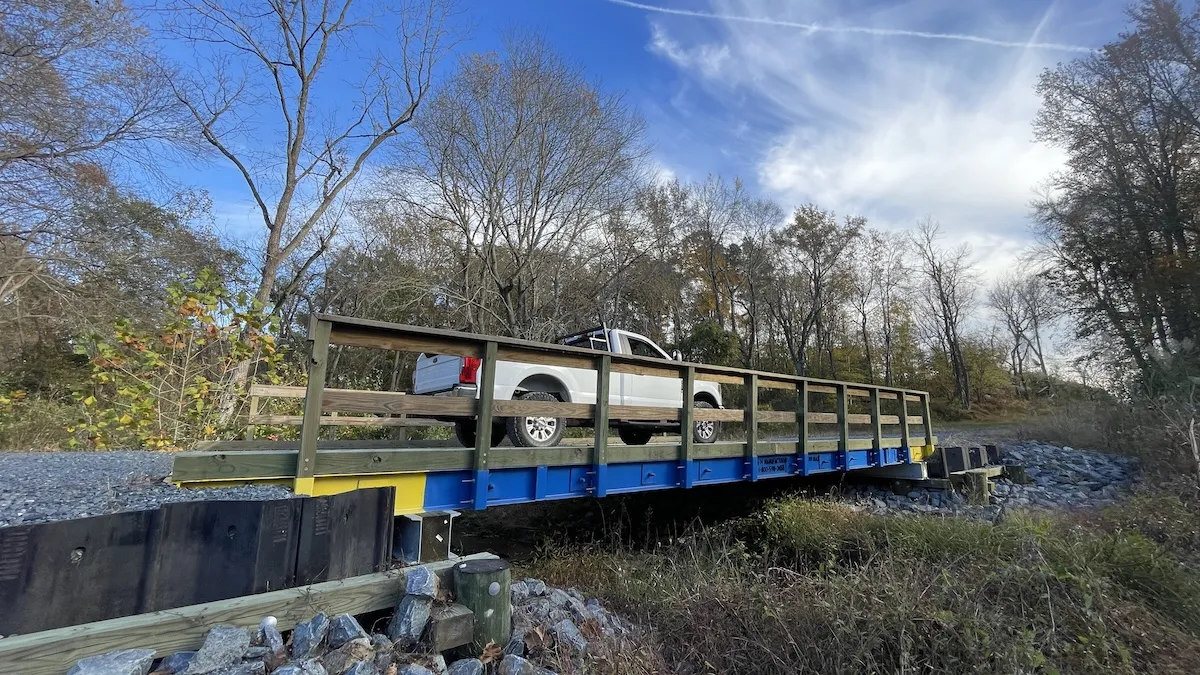
Viewed from the field edge, the bridge looks unassuming with its modest railings and abutments blending into the banks. But its quiet function belies its importance.
It's a structure that does exactly what it was designed to do: carry heavy loads over delicate ground, safely and efficiently, while meeting the layered demands of engineering, permitting, and public trust.
For E&H Bridges, whose systems have served in similar applications throughout the mid-Atlantic region for nearly two decades, the Lakeside installation adds another example of how modular timber bridges can solve practical access problems in environmentally sensitive settings, without overcomplicating the solution.
Bridge Specifications — Lakeside at Trappe
In the end, it's just a bridge. But in a project defined by complexity, transparency, and constant review, that bridge quietly does what few structures manage to do in such a climate—it carries the weight.