
North Carolina's trail systems are expanding fast. From new greenway segments connecting communities in the Piedmont to backcountry trail extensions in the Blue Ridge, parks departments and land trusts are building more trail miles than ever. Nearly every route eventually hits a stream crossing. When that happens, you need a bridge that fits the setting, meets the engineering requirements, and doesn't stall the project timeline while you wait for custom fabrication or a complicated permitting review.
The challenge for most trail projects is finding a crossing solution that checks every box at once: structurally rated for the expected traffic, low visual impact in a natural environment, simple enough to install with the equipment you already have on-site, and favorable in the eyes of the agencies reviewing your permit application. Off-the-shelf culverts block fish passage and look out of place. Custom steel or concrete bridges take months to design and build. A pre-engineered timber bridge solves all of these problems with a single product that arrives ready to set.
Why Timber Bridges for Trail Crossings
Natural Appearance in Trail Settings
Timber blends into wooded and natural landscapes in a way that steel, concrete, and plastic simply cannot. Trail users see a bridge that belongs, not an industrial structure dropped into the woods.
No Crane Required
Each panel weighs approximately 4,900 lbs and can be placed with a standard excavator or backhoe, equipment most trail construction crews already have on-site.
Open Span Preserves the Stream
No in-stream piers or fill material. The full streambed stays intact underneath, maintaining natural flow, aquatic habitat, and sediment transport.
Rated for More Than Foot Traffic
At 38,000 lbs capacity, the SL30-06-19 handles not just hikers and bikes but also maintenance vehicles, UTVs, and emergency equipment that need periodic trail access.
PE-Stamped Engineering Included
Every bridge ships with professional engineer certification and plan sheets. No need to hire a structural engineer separately or wait for custom design work.
Flexible Configuration
Use a single 6'6" panel for a narrow hiking trail or lock two panels together for a 13-foot-wide surface that accommodates multi-use paths and maintenance vehicles.
Recommended Model for Trail Crossings
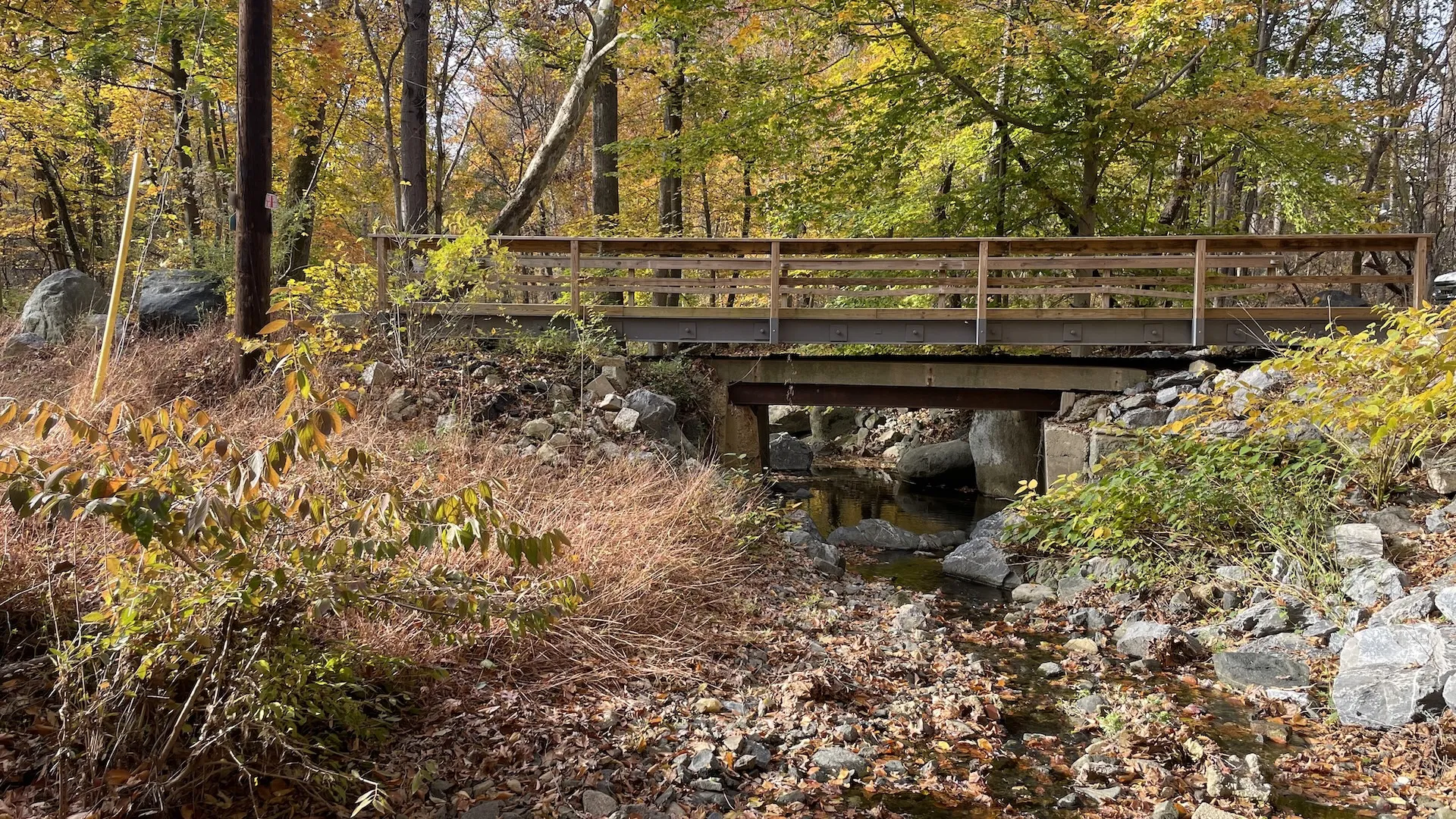
Most trail stream crossings in North Carolina span 8 to 18 feet: headwater tributaries in the mountains, Piedmont creek crossings on greenway routes, and coastal plain streams along nature preserve trails. The SL30-06-19 is the ideal fit for these applications. It's the lightest and most economical model in the E&H lineup, with a 20-foot maximum clear span that covers the vast majority of trail crossing needs. For narrow hiking or biking trails, a single 6'6" panel is often all you need. For wider multi-use paths or trails that require periodic maintenance vehicle access, two panels assemble into a 13-foot-wide crossing.
30-foot stress-laminated timber bridge constructed from 2" x 6" CCA-treated southern yellow pine, encased in 6" x 13 lb/ft structural steel channel. Arrives fully assembled with all hardware, curb beams, and shear plates.
Single-panel and full two-panel configurations available. For trail spans exceeding 20 feet, the SL40-06-11 (30 ft max clear span) is available as an upgrade. Contact us for current inventory and pricing.
How It Compares
In the trail bridge market, the most common alternatives to timber are fiberglass (FRP) composite bridges and recycled plastic lumber bridges. Both are marketed as low-maintenance options for trail settings. Here's how a pre-engineered stress-laminated timber bridge compares for North Carolina trail projects.
| Factor | Timber Bridge | FRP / Fiberglass Bridge | Recycled Plastic Bridge |
|---|---|---|---|
| Load Capacity | 38,000 lb (PE-stamped) | Varies widely by manufacturer | Typically limited to pedestrian |
| Natural Appearance | Real wood (blends with forest) | Synthetic appearance | Simulated wood look |
| Structural Certification | PE-stamped plan sheets included | May require separate engineering | Limited engineering documentation |
| Install Equipment | Excavator only (no crane) | Crane often required for longer spans | Varies (some require crane) |
| Field Repair | Standard lumber and hardware | Specialty materials required | Specialty materials required |
| Proven Track Record | Decades of timber bridge use in parks | Newer technology (less field history) | Limited long-term performance data |
| Cost | Competitive (request a quote) | Typically 30-60% higher | Comparable for short spans |
| Relocatable | Yes (pick up and move) | Possible but difficult | Possible for small spans |
Permitting Considerations in North Carolina
Trail bridge projects in North Carolina that involve streams or wetlands require federal and state permits. At the federal level, the Army Corps of Engineers Wilmington District administers Section 404 permits for any structure placed in or over waters of the United States. Pre-engineered timber bridges with open spans typically qualify for Nationwide Permit 14 (Linear Transportation Projects) or Nationwide Permit 3 (Maintenance), which are significantly faster to obtain than individual 404 permits, often taking weeks instead of months.
At the state level, the NC Division of Water Resources issues Section 401 Water Quality Certifications and administers the state's buffer rules. North Carolina's riparian buffer regulations are among the most specific in the Southeast, particularly in the Neuse and Tar-Pamlico river basins where 50-foot buffers are standard. Timber bridges are favorable in this context because the open-span design avoids permanent fill in the buffer zone and minimizes the footprint of disturbance during installation.
For projects receiving state or federal funding (which includes many trail projects funded through the NC Parks and Recreation Trust Fund or the federal Recreational Trails Program), additional environmental review under NEPA or the NC State Environmental Policy Act (SEPA) may be required. The low-impact nature of a pre-engineered timber bridge installation generally simplifies these reviews. Local erosion and sediment control permits are also required during the construction phase, administered by the NC Division of Energy, Mineral, and Land Resources.